# Schedule for College of Communication Volga State Goverment University of ICT (КС ПГУТИ)
Reskin of https://lk.ks.psuti.ru/ since it lacks mobile support.
[](https://nextjs.org/)
[](https://react.dev/)
[](https://www.typescriptlang.org/)
[](https://tailwindcss.com/)
[](https://ui.shadcn.com/)
[](https://www.sqlite.org/)
[](https://www.docker.com/)
[](https://core.telegram.org/bots/api)
[](https://schedule.itlxrd.space/)
[](https://github.com/kilyabin/kspguti-schedule/blob/master/LICENSE)
Screenshots:

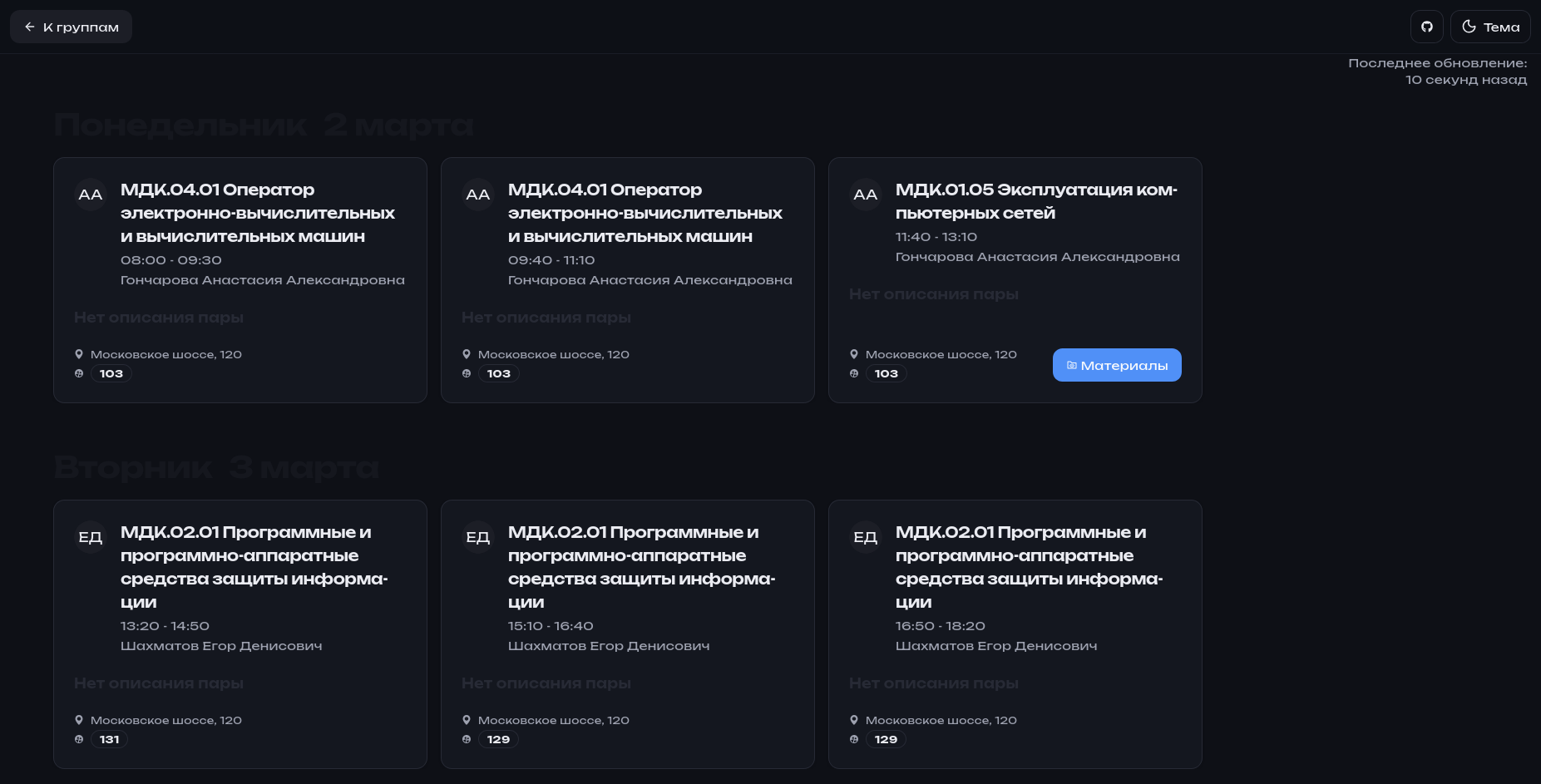
Old screenshots (2023)
[](https://schedule.itlxrd.space/)
[](https://schedule.itlxrd.space/)
## Tech stack & features
- React 19.2.0 with Next.js 16.1.6 (pages router)
- Tailwind CSS
- @shadcn/ui components (built with Radix UI)
- JSDOM for parsing scraped pages, rehydration strategy for cache
- TypeScript 5.9.3 with types for each package
- SQLite database (better-sqlite3) for storing groups and settings
- bcrypt for secure password hashing
- Telegram Bot API (native `fetch`) for parsing failure notifications
- Custom [js parser for teachers' photos](https://gist.github.com/VityaSchel/28f1a360ee7798511765910b39c6086c)
- Accessibility & tab navigation support
- Dark theme with automatic switching based on system settings
- Admin panel for managing groups and settings
- Optimized code structure with reusable utilities and components
- Optional auto-sync of groups from `lk.ks.psuti.ru` controlled by env
## Architecture & Code Organization
The project follows a feature-sliced design pattern with clear separation of concerns:
**Code Structure:**
- **Shared utilities** (`src/shared/utils/`):
- `auth.ts` - Authentication and session management
- `api-wrapper.ts` - Reusable API route wrappers with auth and error handling
- `validation.ts` - Centralized validation functions
- **Data layer** (`src/shared/data/`):
- SQLite database for persistent storage
- Data loaders with caching (1-minute TTL)
- Automatic cache invalidation on updates
- **API routes** (`src/pages/api/admin/`):
- Unified authentication via `withAuth` wrapper
- Consistent error handling
- Method validation
- **Components**:
- Reusable UI components in `src/shared/ui/`
- Feature-specific components in `src/features/`
- Complex widgets in `src/widgets/`
**Optimizations:**
- Toggle switch component reused across admin panel
- Unified data loading functions
- Centralized validation logic
- Consistent API error handling
- Optimized cache management
## Known issues
- Previous week cannot be accessed if you enter from main "/"
Workaround: Locate to next week, then enter previous twice.
## Schedule modes
The behaviour of group management and data source is controlled by the `SCHED_MODE` environment variable:
- `hobby` (default):
- Groups are managed manually via the admin panel (add/edit/delete).
- The app uses whatever is stored in the local SQLite `groups` table.
- `kspsuti`:
- On the server, the app periodically fetches `https://lk.ks.psuti.ru/?mn=2`, parses the group list (day + distance), and synchronises it into the local database.
- The admin panel shows the current groups but disables manual editing/removal — groups are treated as read‑only and must be changed on the college site.
- All pages that call `loadGroups()` automatically work with the synced list.
Set `SCHED_MODE=kspsuti` during deployment to enable automatic group syncing; omit it or set `SCHED_MODE=hobby` to keep the previous manual workflow.
## Project structure
```
kspguti-schedule/
├── src/ # Source code
│ ├── app/ # App-level code
│ │ ├── agregator/ # Schedule fetching logic
│ │ ├── parser/ # HTML parsing for schedule
│ │ └── utils/ # App-level utilities
│ ├── pages/ # Pages router (Next.js)
│ │ ├── api/ # API routes
│ │ │ └── admin/ # Admin panel API endpoints
│ │ │ ├── groups.ts # Groups CRUD operations
│ │ │ ├── settings.ts # Settings management
│ │ │ ├── login.ts # Authentication
│ │ │ ├── check-auth.ts # Auth verification
│ │ │ ├── change-password.ts # Password change
│ │ │ └── logs.ts # Error logs viewer
│ │ ├── [group].tsx # Dynamic group schedule page
│ │ ├── admin.tsx # Admin panel page
│ │ └── index.tsx # Home page
│ ├── entities/ # Business entities
│ ├── features/ # Feature modules
│ │ ├── add-group/ # Add group feature
│ │ └── theme-switch/ # Theme switcher
│ ├── shared/ # Shared code
│ │ ├── constants/ # App constants
│ │ ├── context/ # React contexts
│ │ ├── data/ # Data layer
│ │ │ ├── database.ts # SQLite database operations
│ │ │ ├── groups-loader.ts # Groups data loader
│ │ │ └── settings-loader.ts # Settings data loader
│ │ ├── model/ # Data models
│ │ ├── providers/ # React providers
│ │ ├── ui/ # Shared UI components
│ │ └── utils/ # Utility functions
│ │ ├── auth.ts # Authentication utilities
│ │ ├── api-wrapper.ts # API route wrappers
│ │ └── validation.ts # Validation utilities
│ ├── shadcn/ # shadcn/ui components
│ └── widgets/ # Complex UI widgets
│ ├── navbar/ # Navigation bar
│ └── schedule/ # Schedule display components
├── public/ # Static assets
│ └── teachers/ # Teacher photos
├── old/ # Deprecated/archived files
│ ├── data/ # Old data files (groups.ts, groups.json)
│ └── README.md # Documentation for old files
├── scripts/ # Deployment scripts
├── systemd/ # Systemd service file
├── db/ # SQLite database files
├── components.json # shadcn/ui config
├── docker-compose.yml # Docker Compose config
├── Dockerfile # Docker image definition
├── next.config.js # Next.js configuration
├── tailwind.config.js # Tailwind CSS config
└── tsconfig.json # TypeScript config
```
## Development
### Prerequisites
- Node.js 20+ (see `.nvmrc`)
- npm 10+ or pnpm
### Local development
```bash
# Install dependencies
npm install
# Run development server
npm run dev
```
### Admin Panel
The application includes an admin panel for managing groups and application settings. Access it at `/admin` route.
**Features:**
- Manage groups (add, edit, delete)
- Configure application settings (e.g., week navigation)
- Password-protected access with session management (24-hour sessions)
- Change admin password from the admin panel
- View error logs
- Debug options (development mode only)
**Security:**
- Passwords are hashed using bcrypt
- Session-based authentication with secure cookies
- Rate limiting on login attempts (5 attempts per 15 minutes)
- Default password warning if not changed
**Default password:**
- On first launch, the default password is `ksadmin`
- ⚠️ **Important:** Change the default password immediately after first login for security!
- The admin panel will show a warning if the default password is still in use
**Password recovery:**
- If you forgot your admin password, you can reset it using the provided scripts
- See `scripts/RESET_PASSWORD.md` for detailed instructions
- Quick reset: `node scripts/reset-admin-password.js "new_password"`
**Environment variables for admin panel:**
- `ADMIN_SESSION_SECRET` - Secret key for session tokens (optional, defaults to 'change-me-in-production')
- `ADMIN_PASSWORD` - Initial admin password (optional, defaults to 'ksadmin')
⚠️ **Important:** Always set a strong `ADMIN_SESSION_SECRET` in production!
**API Endpoints:**
- `GET /api/admin/groups` - Get all groups
- `POST /api/admin/groups` - Create new group
- `PUT /api/admin/groups/[id]` - Update group
- `DELETE /api/admin/groups/[id]` - Delete group
- `GET /api/admin/settings` - Get settings
- `PUT /api/admin/settings` - Update settings
- `POST /api/admin/login` - Authenticate
- `GET /api/admin/check-auth` - Check authentication status
- `POST /api/admin/logout` - Logout
- `POST /api/admin/change-password` - Change password
- `GET /api/admin/logs` - Get error logs
### Docker deployment
#### Build and run with Docker
```bash
# Build the image
docker build -t kspguti-schedule .
# Run the container
docker run -p 3000:3000 kspguti-schedule
```
#### Using Docker Compose
```bash
# Build and start
docker-compose up -d
# View logs
docker-compose logs -f
# Stop
docker-compose down
```
**Environment variables:** Edit `docker-compose.yml` to add your environment variables:
- `PROXY_URL` - URL for schedule parsing (optional)
- `PARSING_FAILURE_NOTIFICATIONS_TELEGRAM_BOTAPI_TOKEN` - Telegram bot token (optional)
- `PARSING_FAILURE_NOTIFICATIONS_TELEGRAM_CHAT_ID` - Telegram chat ID (optional)
- `ADMIN_SESSION_SECRET` - Secret key for session tokens (optional, but recommended in production)
- `NEXT_PUBLIC_SITE_URL` - Site URL for canonical links and sitemap (optional)
**Database:**
- The application uses SQLite database (`db/schedule-app.db`) for storing:
- Groups configuration
- Application settings
- Admin password (hashed with bcrypt)
- Database is automatically created on first run in the `db/` directory at the project root
- Database directory is excluded from deployment scripts to preserve data
- No additional database setup required
**Note:** Admin password is stored in SQLite database. Default password is `ksadmin` - change it after first login!
### Production deployment
#### Netlify
The project includes `netlify.toml` for automatic deployment configuration.
#### Docker
The Dockerfile uses Next.js standalone output for optimized production builds. The image includes:
- Multi-stage build for smaller image size
- Non-root user for security
- Health checks
- Production optimizations
#### System installation (Linux systemd)
Install the application directly on a Linux system as a systemd service:
**Prerequisites:**
- Linux system with systemd
- Node.js 20+ installed
- Root/sudo access
- ICU library (for Node.js):
- Arch Linux: `sudo pacman -S icu`
- Ubuntu/Debian: `sudo apt-get install libicu-dev`
- Fedora/RHEL/CentOS: `sudo dnf install libicu` or `sudo yum install libicu`
**Installation:**
```bash
# Clone the repository
git clone
cd kspguti-schedule
# Copy example and edit .env
cp .env.production.example .env
nano .env
# Run the installation script
sudo ./scripts/install.sh
```
The installation script will:
- Check Node.js and npm versions
- Copy files to `/opt/kspguti-schedule`
- Install dependencies
- Build the production version
- Install and enable systemd service
**Configuration:**
1. Edit environment variables:
```bash
sudo nano /opt/kspguti-schedule/.env
```
The installation script will:
- Copy `.env` file from source directory if it exists
- Preserve existing `.env` in installation directory if it already exists
- Create `.env` from `.env.production.example` if no `.env` file is found
2. Update systemd service if needed:
```bash
sudo nano /etc/systemd/system/kspguti-schedule.service
```
**Managing the service:**
Use the management script for easy service control:
```bash
# Start the service
sudo ./scripts/manage.sh start
# Stop the service
sudo ./scripts/manage.sh stop
# Restart the service
sudo ./scripts/manage.sh restart
# Check status
./scripts/manage.sh status
# View logs
./scripts/manage.sh logs
./scripts/manage.sh logs -f # Follow logs
# Update application
sudo ./scripts/manage.sh update
# Enable/disable autostart
sudo ./scripts/manage.sh enable
sudo ./scripts/manage.sh disable
```
**Service configuration:**
- Installation directory: `/opt/kspguti-schedule`
- Service user: `www-data`
- Port: `3000` (configurable via environment variables)
- Logs: `journalctl -u kspguti-schedule`
**Environment variables:**
See `.env.production.example` for available options. The application uses `.env` file in production:
**Schedule parsing:**
- `PROXY_URL` - URL for schedule parsing (optional, defaults to https://lk.ks.psuti.ru)
- `PARSING_FAILURE_NOTIFICATIONS_TELEGRAM_BOTAPI_TOKEN` - Telegram bot token for parsing failure notifications (optional)
- `PARSING_FAILURE_NOTIFICATIONS_TELEGRAM_CHAT_ID` - Telegram chat ID for receiving notifications (optional)
**Admin panel:**
- `ADMIN_PASSWORD` - Initial password for admin panel access (optional, defaults to 'ksadmin')
- `ADMIN_SESSION_SECRET` - Secret key for session tokens (optional, defaults to 'change-me-in-production', but should be changed in production)
**Note:** The admin password is stored in SQLite database and can be changed from the admin panel. The `ADMIN_PASSWORD` environment variable is only used for initial setup.
**Site configuration:**
- `NEXT_PUBLIC_SITE_URL` - Site URL for canonical links and sitemap (optional, defaults to https://schedule.itlxrd.space)
#### Other platforms
The project can be deployed to any platform supporting Node.js 20+:
- Vercel
- Railway
- DigitalOcean App Platform
- AWS App Runner
- Any Docker-compatible platform